


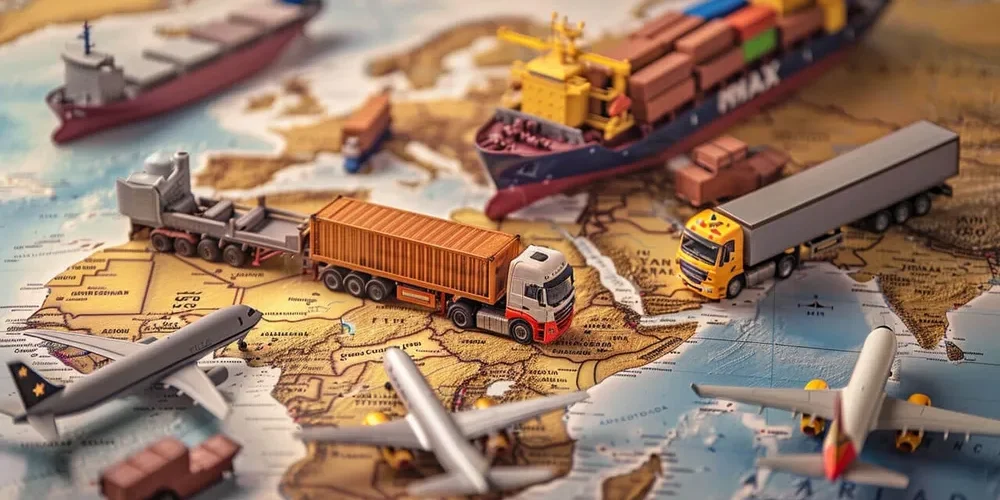
International shipping is no longer a linear process — it is a multi-layered operation involving transportation, customs compliance, warehousing, and cross-border coordination. In Oman, where cargo moves through strategic hubs such as Sohar, Salalah, and Muscat, fragmented logistics execution often leads to delays, cost overruns, and operational inefficiencies.
End-to-end logistics is not just a service model — it is a control framework that integrates every stage of the supply chain under a single operational structure.
What End-to-End Logistics Actually Means in Practice
End-to-end logistics is often misunderstood as “bundled services.” In reality, it is about centralized control over the entire cargo lifecycle, including:
- Origin coordination
- Multi-modal transportation (road, sea, air)
- Customs clearance and regulatory handling
- Warehousing and distribution
- Final delivery execution
Instead of managing multiple vendors, businesses operate through a single logistics command structure, reducing fragmentation and execution gaps.
Why Fragmented Logistics Fails in Oman’s Trade Environment
Oman’s logistics ecosystem involves:
- Cross-border GCC transport (UAE, Saudi Arabia)
- Port-based imports and exports
- Compliance-heavy customs procedures
When different vendors handle each stage:
- Communication breaks down
- Documentation errors increase
- Responsibility becomes unclear
- Delays multiply across stages
Fragmentation is the root cause — not the symptom.
Operational Simplification Through Centralized Control
With end-to-end logistics:
- Shipment booking, documentation, transport, and delivery are aligned
- There is no dependency on multiple intermediaries
- Execution flows through a single operational system
This eliminates:
- Miscommunication between vendors
- Duplicate handling processes
- Delays caused by coordination gaps
In logistics, simplicity is not basic — it is engineered.
Cost Efficiency Through Integrated Execution
Cost reduction doesn’t come from cheaper freight — it comes from controlled operations.
End-to-end logistics reduces:
- Administrative overhead
- Re-handling costs
- Delays that lead to penalties
- Redundant service charges
Additionally, integrated providers leverage:
- Carrier networks
- Consolidated shipments
- Optimized routing
This results in measurable cost efficiency across the supply chain.
Full Visibility Across the Supply Chain
Without visibility, logistics becomes reactive.
End-to-end systems provide:
- Real-time shipment tracking
- Status updates across all stages
- Centralized reporting
This allows businesses to:
- Identify disruptions early
- Adjust logistics decisions in real time
- Maintain delivery commitments
Visibility is not about tracking — it is about control.
Compliance and Customs Control in Oman
Customs clearance in Oman is a critical control point.
Risks include:
- Incorrect documentation
- Regulatory non-compliance
- Delays in approvals and inspections
End-to-end logistics ensures:
- Documentation is prepared and verified in advance
- Clearance processes are managed internally
- Regulatory requirements are consistently met
This significantly reduces the risk of shipment holds and penalties.
Faster and Predictable Transit Performance
Speed in logistics is not just about transport — it is about coordination efficiency.
With end-to-end execution:
- Delays between stages are minimized
- Handling is synchronized
- Routing decisions are optimized
This results in:
- Reduced transit time variability
- More predictable delivery schedules
- Improved reliability for time-sensitive cargo
Scalability for Growing Trade Operations
As businesses expand across GCC and international markets, logistics complexity increases.
End-to-end logistics provides:
- Flexible transport modes (FTL, LTL, air, sea)
- Scalable warehousing solutions
- Adaptability to volume fluctuations
This allows businesses in Oman to:
- Scale operations without restructuring logistics
- Enter new markets with operational support
- Maintain consistency despite growth
Strengthening Customer Experience Through Reliability
Customer dissatisfaction is often caused by:
- Late deliveries
- Lack of updates
- Damaged or mishandled shipments
End-to-end logistics improves:
- Delivery consistency
- Shipment transparency
- Communication with end customers
Reliability becomes a competitive advantage — not just an operational outcome.
Conclusion: End-to-End Logistics Is About Control, Not Convenience
Most businesses adopt end-to-end logistics for convenience — but the real value lies in operational control.
In Oman’s logistics environment, where compliance, coordination, and cross-border execution are critical, fragmented logistics creates risk at every stage.
End-to-end logistics eliminates that risk by:
- Centralizing execution
- Strengthening compliance
- Improving visibility
- Reducing cost inefficiencies
ALSI Oman operates with a fully integrated logistics model, ensuring that every shipment moves through a controlled, compliant, and optimized supply chain.